Hume and Hovell’s Overland Journey near Geelong. Who do you think did it?
Additional Information
Captain Hovell confirms the locations of his expedition near Geelong
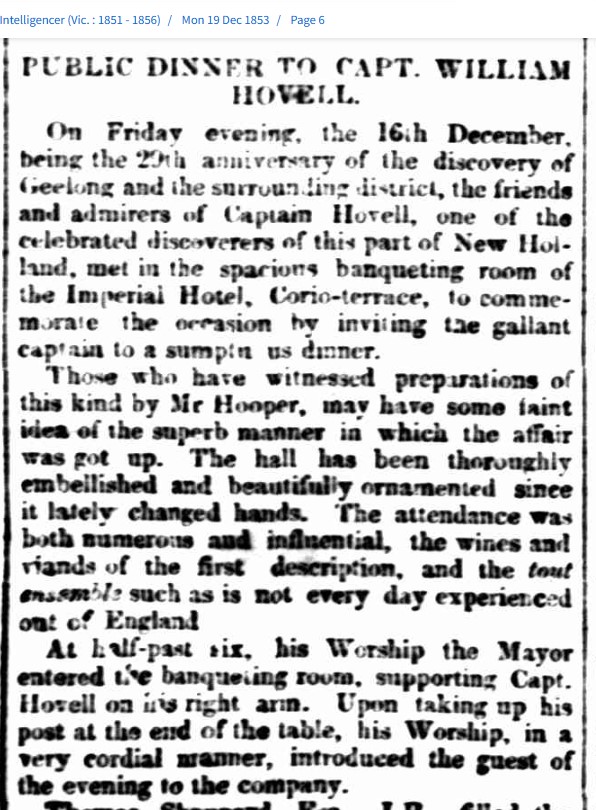
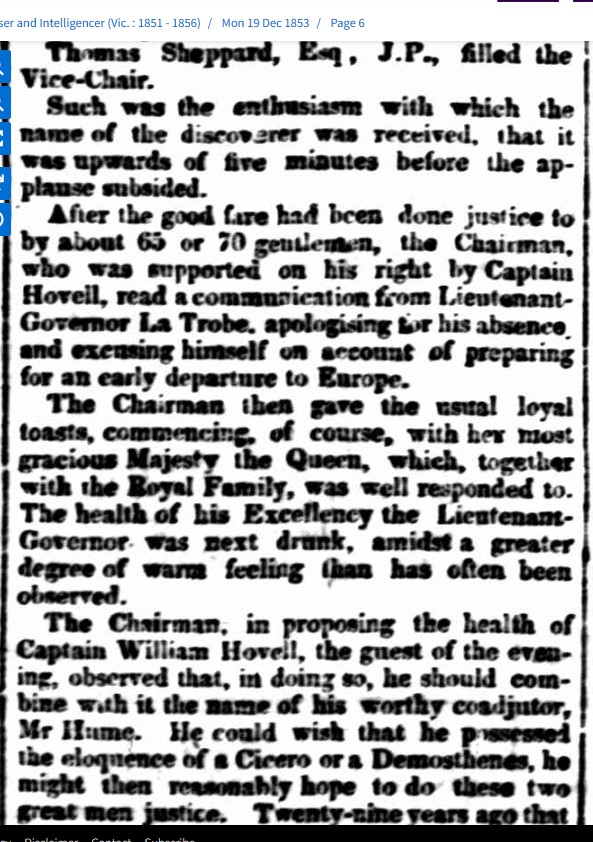
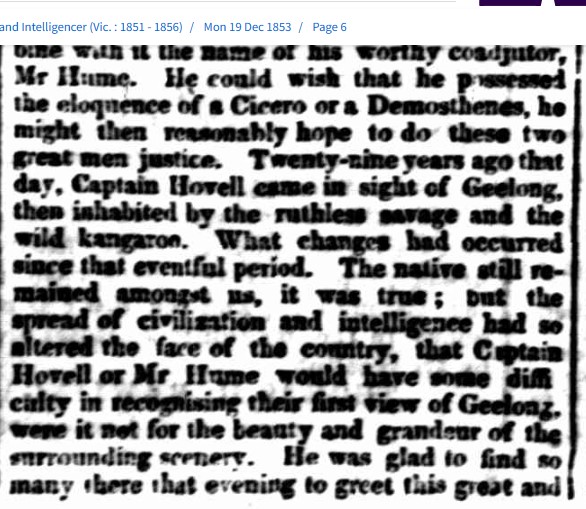
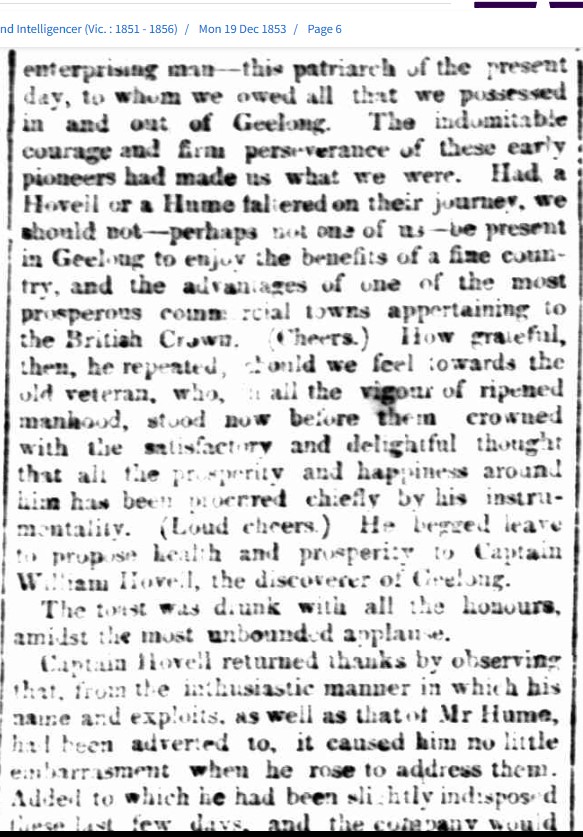
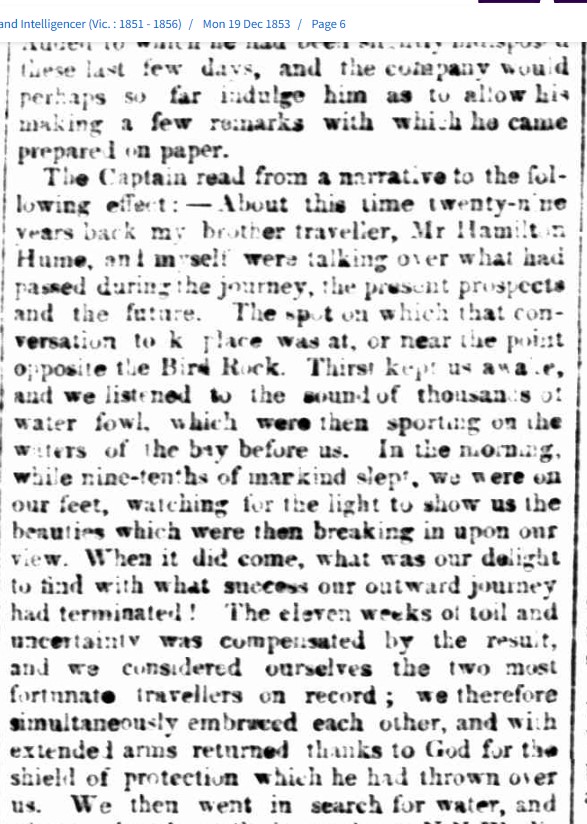
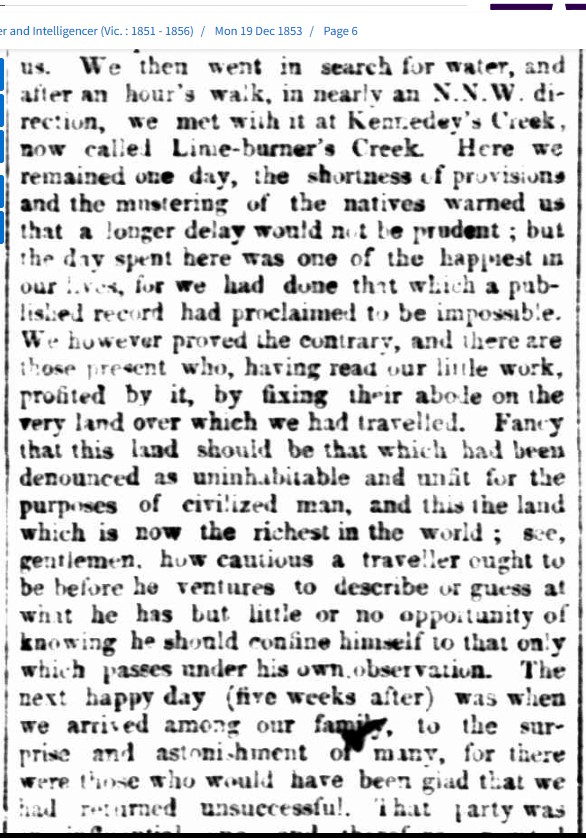
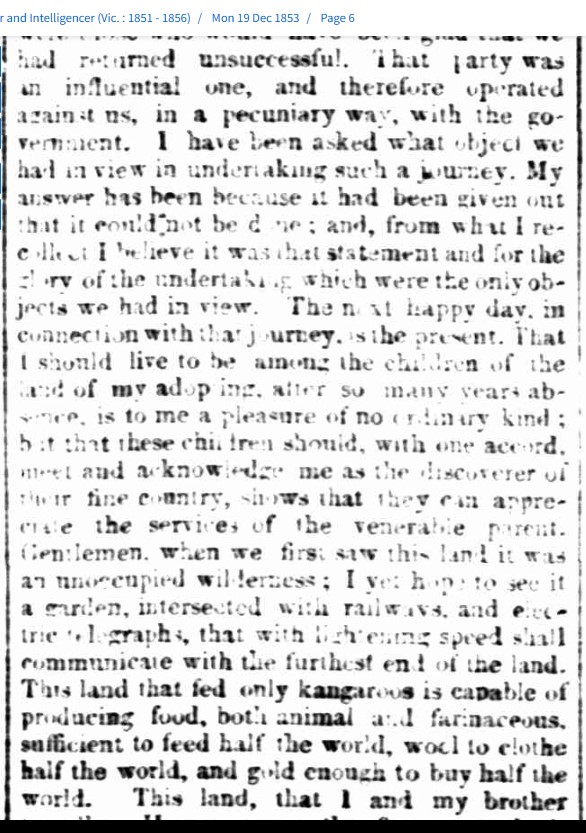
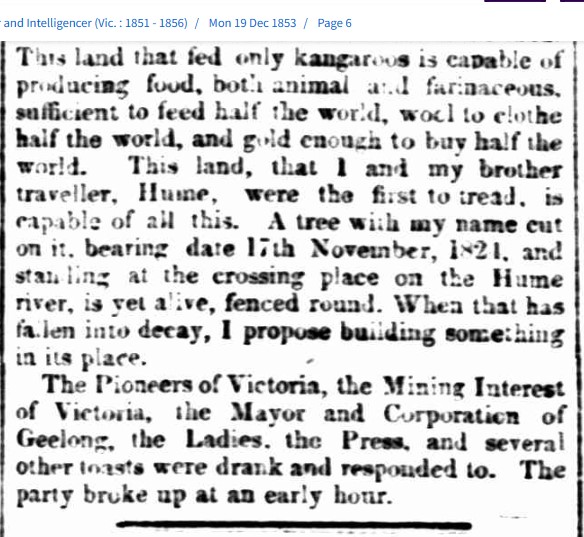
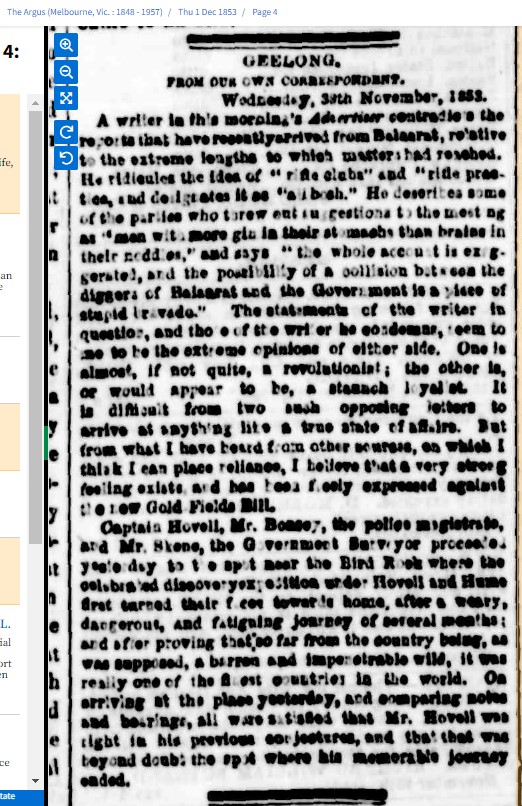
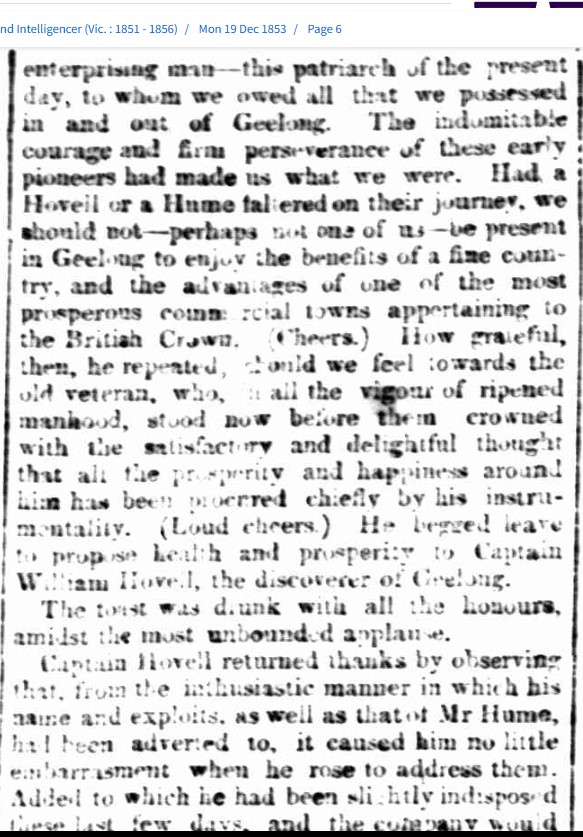
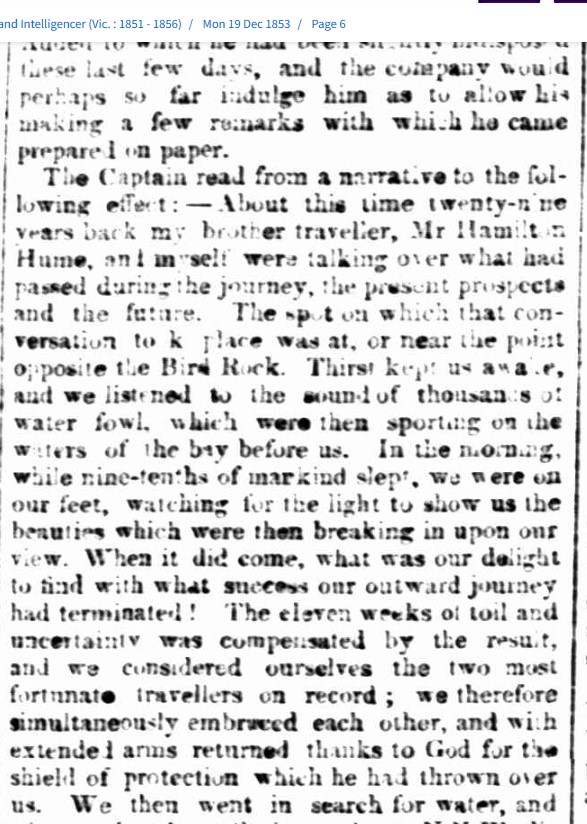
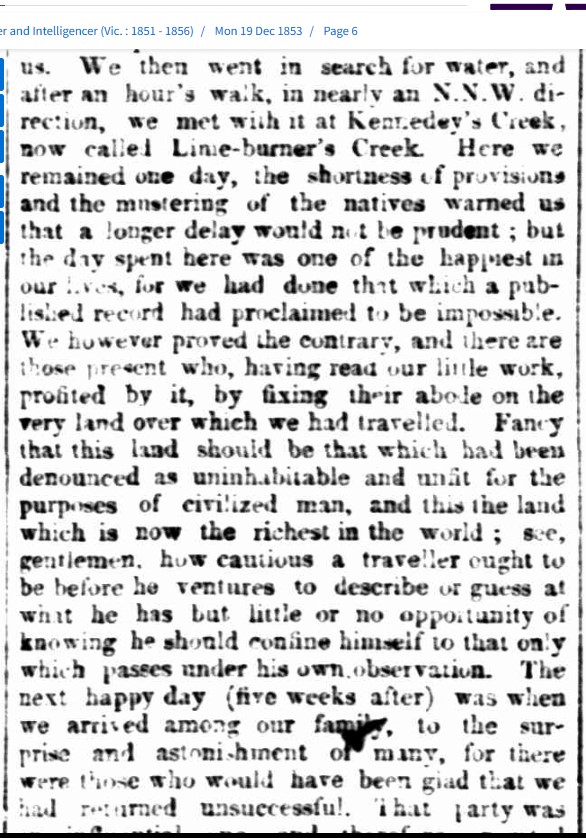
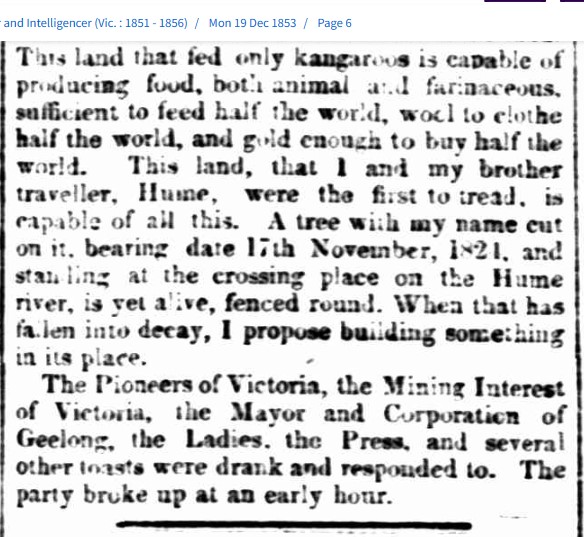
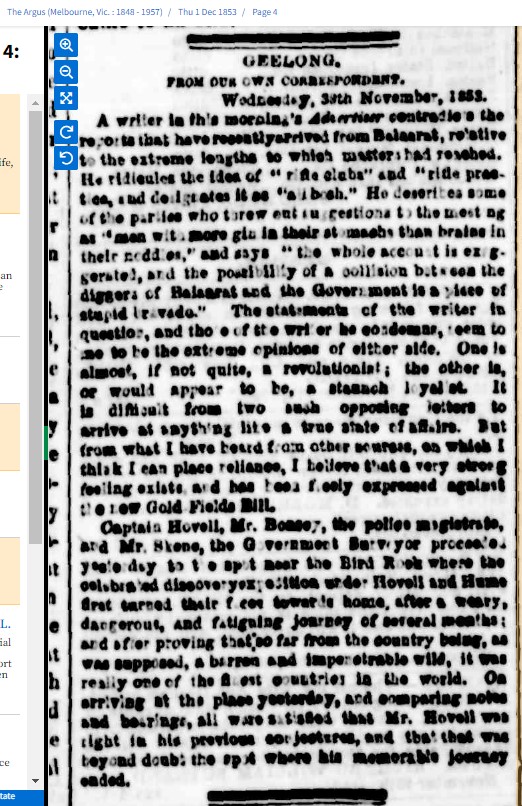
On December 16th, 1853 exactly twenty-nine years to the day that he camped on the banks of Kennedey’s Creek (now Hovell’s Creek), Captain Hovell was a guest at a public dinner in his honour. The dinner was attended by about 70 Geelong citizens. In fact, it was a banquet held at the Imperial Hotel in Corio Terrace. A very detailed description of the proceedings of the evening and his recollections were printed in the Geelong Advertiser and Intelligencer on Monday, December 19th, 1853. That long article can be found below. Another article from Melbourne’s Argus newspaper on December 1st is also attached with a similar affirmation of Bird Rock as the final place of his expedition. I hope you enjoy reading them.
More about the story…..
Fitzpatrick’s encounter
Here what Hume, Fitzpatrick and Boyd said about the incident. It tells us something about Captain Hovell.
Conversation with the Natives – Fitzpatrick Account
Fitzpatrick’s version of the encounter was the same as Hume’s.
“They described the action of men pulling boats, cutting trees and rolling logs; they used white men’s expressions and pointed at the same time over the hills in sight of us, intimating, apparently, that white men and ships were there.”
Was that a cannon? Boyd and Hovell’s Recollection
Hume’s and Hovell’s Observations – Fauna, Flora, Landscape and Native Language
Local reminders of Hume and Hovell’s visit……..
My Speculation
…. a theory without clear, verifiable evidence.
Here is my answer to the question: Who fired the cannon?
My theory is premised on the following details from the story and a knowledge of the period and tries to answer the who, what, why, when and where, questions.
I believe the cannon is fired from a sealer’s ship anchored at the mouth of Cowie’s Creek and it was fired to attract the Hume and Hovell party.
In arriving at this conclusion I have selected the following factors from the story. I draw upon the:
- knowledge that 1824 was pre European settlement of the area;
- natives’ description of a ship, people and activities;
- requirements of a sailing ship that is working for a long period in the area in 1824;
- kind of economic activity pursued in 1824 by ships working for long periods from their port;
- geography of Corio Bay and most likely location where a ship can replenish supplies;
- consensus among that group the sound was a cannon;
- reasons why a cannon would be fired;
- direction Hume estimated the sound originated and the fact that it was largely over water and flat land; and
- physical distance natives would have to travel by foot to travel between the ship and the camp.
Here is the evidence for my conclusion
Geelong wasn’t settled by Europeans until 1836.
Why would a ship be at Cowie’Creek?
Sailing ships required fresh water and wood for their kitchens. Cowie’s Creek had features important for replenishment
- It was protected, sheltered, small bay with a freshwater creek to replenish drinking water.
- Access to the land was flat, whereas the majority of the bay had small cliffs preventing landing and there was no fresh water available.
- The terrain was a small valley, with fertile soil suitable for growing trees that could be cut for firewood.
- Land access also provide the opportunity for hunting animal and birds near fresh water.
- In 1803 Lieutenant Tuckey had used Cowie’s Creek for shelter and fresh water.
What kind of ship could it be?
It is unlikely to be a government sponsored vessel, otherwise its visit would be recorded, so it must be a privately owned ship. The New South Wales Governor, Sir Richard Bourke, had given his approval and would have notified Hume and Hovell if a ship would greet them.
Privately owned ships that are wandering the seas are likely to be those involved in whaling or sealing. Whaling ships are usually very large, but sealers had small ships. Thousands of Seal skins were being harvested in Bass Strait, with closest locations being Wilson’s Promontory, Western Port, King Island and other islands nearby. I would think it would most likely be a sealers’ ship.
Whatever the ownership or purpose of the ship, it needed a shallow draft to cross the sand bar extending from Point Henry. The depth of the bay is also shallow, so a large ship should be eliminated.
Why was the cannon fired?
There are a number of possibilities for the ship to fire its cannon.
- Perhaps it fired in self-defence from an attack by the Wadawurrung.
- Was it fired to draw the attention of fellow Europeans, such as Hume and Hovell’s Party?.
- Perhaps it was a signal to attract its own crew to return prior to sailing.
Natives’ description
- men pulling boats, cutting trees and rolling logs white men’s expressions pointed over the hills in sight of us, intimating, white men and ships were there.” (Fitzpatrick)
- “They described the sailors, and vessels under sail and made use of some English expressions.
- the direction of the place pointed out by the natives (Hume)
- that a vessel had been in that bay, and that the people had landed; and to imply that both the master and the people were continually in a hurry. They also appeared to point out where the vessel lay, and suiting “the action to the word,” endeavoured to explain that they had seen men felling trees in that direction (Tebb’s1837 story)
On the Sunday morning hearing the sound Hume said it came from the extreme bight of the Bay of Geelong (Corio Quay and Cowies Creek.
“…now bore from us, as nearly as I can recollect, about S.30’ W., and distance in a direct line down the harbour fifteen or sixteen miles..” (Note the Straight line distance between Cowies Creek mouth and the Camp was 15.5 miles in a south west direction!) (Hume)
“ every man except Mr. Hume, heard what they thought was a cannon gun. It appeared to come from the bay, but the distance is very great, and I think too far to be heard from there, notwithstanding the wind came from that direction. Each man had a different conjecture, but each was satisfied of the reality of the thing…” (Hovell)
The natives would have to walk to the ship’s location and they indicated it wasn’t far away, just over the hills from the explorers’ campsite – distance of 9 kilometres.
What do you think?
Hume and Hovell Expedition legacy
When Hume and Hovell decided to venture across land to Port Phillip knowledge of the interior between the two locations was unknown. William Brand, writing about their achievements at the time in, Journey of Discovery to Port Phillip, New South Wales, in 1824 and 1825, gave an indication of the journey’s value at the time. Here is a summary of his views.
Invaluable for every purpose of grazing and agriculture by explaining where arable land can be found.
Discovered of inland streams and rivers
Debunked the theory that the interior was inhabitable and useless for civilization
Gave access to regions that can accommodate large numbers of people.
Many inland towns in New South Wales and Victoria owe their existence to the path the Hume and Hovell blazed and that path is now the source of a double freeway between Melbourne and Sydney.
References
Books
1 Ed. Brand, William, 1837, Journey of Discovery to Port Phillip, New South Wales, in 1824 and 1825, Messrs W. H. Hovell and H. Hume Esquires, second Edition, Published by James Tebb and Printed by Henry Bull, Sydney
2. Ed. ROSS, Reverand William,1855, A Brief Statement of Facts in connexion with an OVERLAND EXPEDITION FROM LAKE GEORGE TO PORT PHILLIP IN 1824, BY HAMILTON HUME, J Moore Bookseller, George Street, Sydney
Internet
2 http://www.sl.nsw.gov.au/discover_collections/history_nation/exploration/hume/maps.html
3 http://www.sl.nsw.gov.au/discover_collections/history_nation/exploration/hume/index.html
4 http://gutenberg.net.au/ebooks04/0400371.txt
Newspaper
5 Geelong Advertiser Page 1 December 18 1923, Hume and Hovell Centenary Celebrations
Maps – Identified within the text
Harry Roberts Map of Camp Location and Route
A Map shewing ”Journey of Discovery’ of HUME AND HOVELL from near Lake George to crossing the Hume NSW – 1824 Courtesy Mitchell Library FL9140692
A Map Showing Track of HUME AND HOVELL ACROSS VICTORIA November AND December 1824 AND January 1825 Courtesy Mitchell Library FL4740578
H. Hume’s sketch of a tour performed by W. H. Hovell and himself from Lake George to Port Phillip, Bass’s Straits, at their own expense in the years 1824 and 1825 through the request of Sir Thomas Brisbane Courtesy Mitchell Library FL3692390
Photographs
unless clearly identified from another source – by Harry Roberts
Portrait of Captain William Hovell in 1866 Mitchell Library FL3238648
Charles Pratt “North Geelong Industrial Area ID 9939657567507636 Courtesy State Library Victoria
Unveiling of Hume and Hovell Monument, 1924, Geelong Advertiser Page 1 December 18 1923
Artwork
Sketches of New South Wales, Tasmania and Victoria, ny Lempriere and others ca. 1830-1868 Mitchell Library ve00344_0008_c “Geelong 30th May, 1854”
Portrait of Captain William Hovell in 1866 Mitchell Library FL3238648
Portrait of Humilton Hume Mitchell Library FL1859557
Picture of Whaler Courtesy of Mitchell Library – https://collection.sl.nsw.gov.au/record/16AP8Pon/QlarlgJMOpDwA

 Investigator Multimedia